

 Image 1 of 1
JSU RESEARCH: K-40 Banana Theory
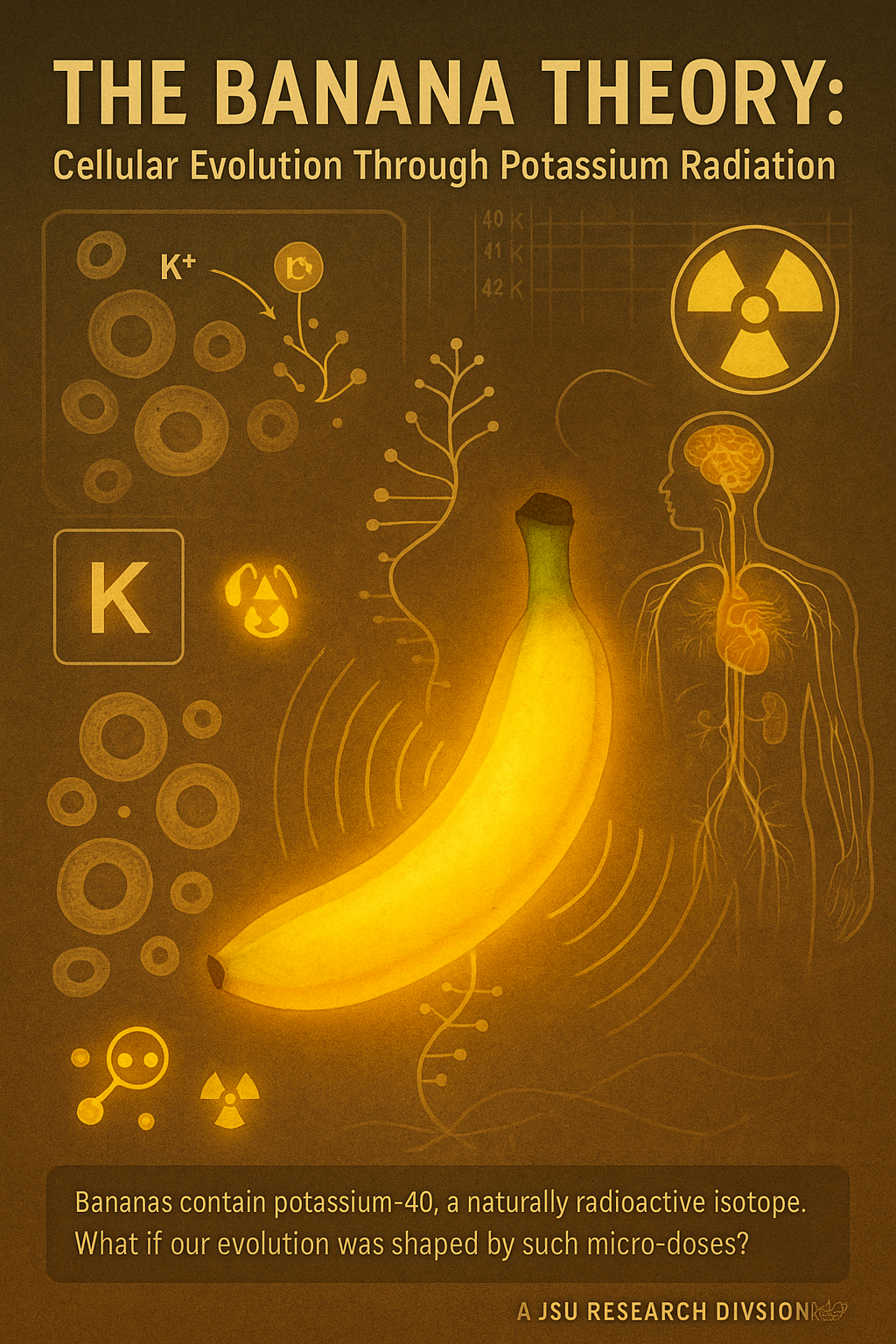
“Radioactive Produce and Cellular Design: Rethinking Potassium’s Role in Human Development” Submitted by: THE JSU TTEE LLC Researcher: Benjamin F. Jones III Radioactive Produce and Cellular Design: Rethinking Potassium’s Role in Human Development Submitted by: THE JSU TTEE LLC Researcher: Benjamin F. Jones III Website: WWW.THEJSU.COM Abstract This paper re-examines potassium as both a nutritional necessity and a subtle yet persistent radiological presence within the human body. While potassium-40 (K40) makes up only a trace amount of naturally occurring potassium, its omnipresence in food and biology warrants reevaluation of its long-term influence on cellular design, organ function, and adaptation. We focus on plant-based sources—particularly bananas—and how their radiation-adaptive characteristics may have shaped human biology through continual dietary exposure. Radioactive Produce and Cellular Design: Rethinking Potassium's Role in Human Development 1 1. Introduction: The Unseen Spark Potassium is a fundamental electrolyte in human physiology, responsible for maintaining cell membrane potentials, muscle contractions, and cardiac rhythms. What is often overlooked is that a measurable fraction of potassium is radioactive: potassium-40 (K-40), which decays by beta and gamma emissions. K-40 is not added to the body artificially—we ingest it naturally from fruits, vegetables, and other staples. 2. Plant Evolution and Radiological Absorption Historical climate shifts and soil dynamics have influenced the adaptive radiationuptake behaviors of plants, particularly post-glacial species that emerged 10,000+ years ago. Potassium-heavy produce like bananas, potatoes, spinach, and beans absorbed isotopes such as K-40 for ionic stability and survival. The original banana cultivar (e.g., Gros Michel), now extinct, may have hosted a unique radiation balance no longer present in modern monocultures like the Cavendish. This introduces not only ecological loss but a potential missing link in subtle nutritional-radioactive balance in human adaptation. 3. Biological Integration of K-40 in Humans Once ingested, potassium—including K-40—is absorbed via the small intestine and regulated primarily by the kidneys. Roughly 0.012% of all potassium in the body is K-40, and yet: It resides in every cell of the body. Emits radiation internally, impacting cells, heart rhythm, and neuronal function. Astronauts require controlled doses of potassium even in space, reinforcing its critical yet radioactive duality. 4. Hypothesis: Potassium as Evolutionary Primer This paper posits that K-40 is not merely tolerated by the human body, but has played a role in evolutionary cellular architecture. By persistently radiating within a biological system: Radioactive Produce and Cellular Design: Rethinking Potassium's Role in Human Development 2 K-40 may influence DNA repair, signal transduction, or membrane evolution. The interplay of dietary isotopes and human cell design could signify a coadaptive evolution. This raises the question: what else are we consuming that silently shapes our cellular programming? 5. Implications & Further Research If plant radiation has played a role in human biology: What are the long-term effects of consuming genetically modified or monocultured produce with altered K-40 ratios? Could potassium-dependence in cardiac and renal systems be a biological trace of this adaptation? Can this insight inform better astronaut nutrition, anti-radiation protocols, or even cancer therapies based on targeted isotopic behavior? Conclusion We are not merely what we eat—we are shaped by what our ancestors consistently ingested. Potassium-40 is a living trace of this reality: a radioactive signature woven into our biological code. As food systems and plant evolution change, we must ask: what else are we losing—besides nutrients—when a banana goes extinct? Submitted by: THE JSU TTEE LLC Independent Research Division WWW.THEJSU.COM Primary Researcher: Benjamin F. Jones III Contracted under THE JSU TTEE LLC Radioactive Produce and Cellular Design: Rethinking Potassium's Role in Human Development 3 📅 Dated: July 22, 2025 📍 Jurisdiction: Michigan, United States
“Radioactive Produce and Cellular Design: Rethinking Potassium’s Role in Human Development” Submitted by: THE JSU TTEE LLC Researcher: Benjamin F. Jones III Radioactive Produce and Cellular Design: Rethinking Potassium’s Role in Human Development Submitted by: THE JSU TTEE LLC Researcher: Benjamin F. Jones III Website: WWW.THEJSU.COM Abstract This paper re-examines potassium as both a nutritional necessity and a subtle yet persistent radiological presence within the human body. While potassium-40 (K40) makes up only a trace amount of naturally occurring potassium, its omnipresence in food and biology warrants reevaluation of its long-term influence on cellular design, organ function, and adaptation. We focus on plant-based sources—particularly bananas—and how their radiation-adaptive characteristics may have shaped human biology through continual dietary exposure. Radioactive Produce and Cellular Design: Rethinking Potassium's Role in Human Development 1 1. Introduction: The Unseen Spark Potassium is a fundamental electrolyte in human physiology, responsible for maintaining cell membrane potentials, muscle contractions, and cardiac rhythms. What is often overlooked is that a measurable fraction of potassium is radioactive: potassium-40 (K-40), which decays by beta and gamma emissions. K-40 is not added to the body artificially—we ingest it naturally from fruits, vegetables, and other staples. 2. Plant Evolution and Radiological Absorption Historical climate shifts and soil dynamics have influenced the adaptive radiationuptake behaviors of plants, particularly post-glacial species that emerged 10,000+ years ago. Potassium-heavy produce like bananas, potatoes, spinach, and beans absorbed isotopes such as K-40 for ionic stability and survival. The original banana cultivar (e.g., Gros Michel), now extinct, may have hosted a unique radiation balance no longer present in modern monocultures like the Cavendish. This introduces not only ecological loss but a potential missing link in subtle nutritional-radioactive balance in human adaptation. 3. Biological Integration of K-40 in Humans Once ingested, potassium—including K-40—is absorbed via the small intestine and regulated primarily by the kidneys. Roughly 0.012% of all potassium in the body is K-40, and yet: It resides in every cell of the body. Emits radiation internally, impacting cells, heart rhythm, and neuronal function. Astronauts require controlled doses of potassium even in space, reinforcing its critical yet radioactive duality. 4. Hypothesis: Potassium as Evolutionary Primer This paper posits that K-40 is not merely tolerated by the human body, but has played a role in evolutionary cellular architecture. By persistently radiating within a biological system: Radioactive Produce and Cellular Design: Rethinking Potassium's Role in Human Development 2 K-40 may influence DNA repair, signal transduction, or membrane evolution. The interplay of dietary isotopes and human cell design could signify a coadaptive evolution. This raises the question: what else are we consuming that silently shapes our cellular programming? 5. Implications & Further Research If plant radiation has played a role in human biology: What are the long-term effects of consuming genetically modified or monocultured produce with altered K-40 ratios? Could potassium-dependence in cardiac and renal systems be a biological trace of this adaptation? Can this insight inform better astronaut nutrition, anti-radiation protocols, or even cancer therapies based on targeted isotopic behavior? Conclusion We are not merely what we eat—we are shaped by what our ancestors consistently ingested. Potassium-40 is a living trace of this reality: a radioactive signature woven into our biological code. As food systems and plant evolution change, we must ask: what else are we losing—besides nutrients—when a banana goes extinct? Submitted by: THE JSU TTEE LLC Independent Research Division WWW.THEJSU.COM Primary Researcher: Benjamin F. Jones III Contracted under THE JSU TTEE LLC Radioactive Produce and Cellular Design: Rethinking Potassium's Role in Human Development 3 📅 Dated: July 22, 2025 📍 Jurisdiction: Michigan, United States