

Current State:
Last Event Stamp
Hello, World!
Influence Balance
Hello, World!
Approved contributions inflenece system reports and evolving entities. Published outputs appear here after review and abstraction.
Hello, World!
Narrative State Paragraph
Hello, World!
Lore Fragments
Event log

The JSU: 4/10/2026 - If the true god/king/MC appeared, the throne is not his/her goal, but an undeniable part of the legacy. through out all time and iterations.
NPC Drift

Former Customer....JOKING!
Symbolism
Serves as the creation of the day.
Former CustomerNPC dev.

SYMBOLISM



“Every detail was thoughtfully executed. We're thrilled with the outcome.”
— RABBY
Big Ideas,
Real Impact.
1st Edition L.O.E.L:
1st T.C. (duh) 2nd) No involuntary 3rd) no fam same galactic area 4th) registered scan after 2nd** 5th) no previous* interference with ignorant or 1rst 6th) Established awareness of predictable outcomes for catastrophe 7th) Awareness for hindsight* young minds still can outsmart. 8th) Strict adherence to maximize accounting measures….. when ineffective halt processes.
First Published Report
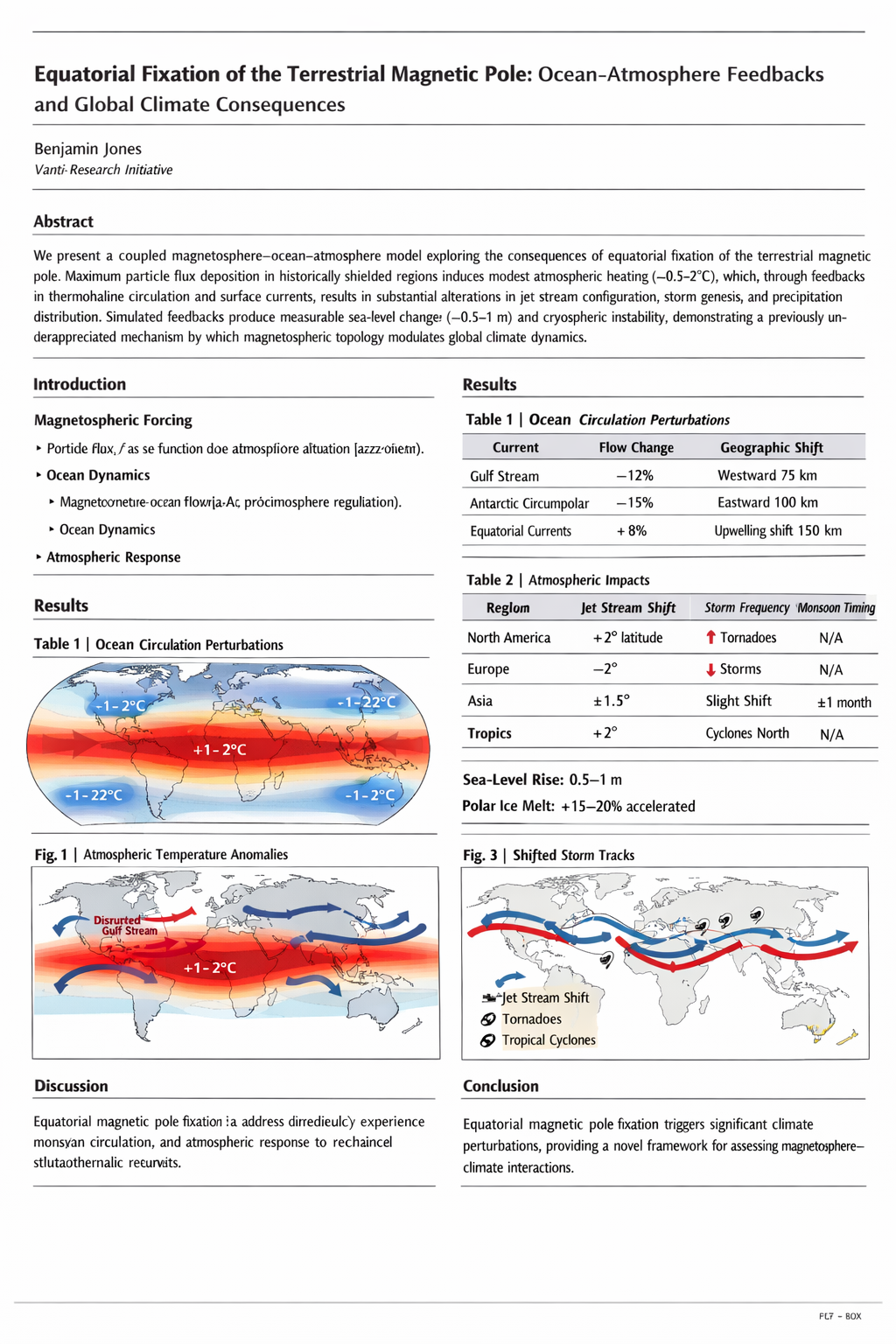
Magnetic Poles: Long term cycles
By: Benjamin Jones III
1. Starting Point — Magnetic Pole at Equator
Magnetic pole latitude: λ = 0°
Particle flux from solar wind: maximum at equator
High-latitude regions: minimal flux
Immediate consequences:
Increased ionization in equatorial atmosphere
Minor atmospheric heating, but enough to slightly alter temperature gradients between equator and poles
Entity:
Solar Wind
2. Ocean Surface Energy Shift
Oceans are primary heat redistributors:
Normally:
Warm equatorial water → rises → moves toward poles
Cold polar water → sinks → moves toward equator (thermohaline circulation)
With equatorial magnetic pole:
Slight atmospheric heating shift → surface water temperatures change by ΔT (even ~0.5–2°C locally)
This disrupts density-driven sinking at poles
Northern and Southern Ocean currents reroute
Mathematically:
Δρ=−αΔT+βΔS\Delta \rho = -\alpha \Delta T + \beta \Delta S
Δρ=−αΔT+βΔS
Where:
ρ = water density
α = thermal expansion coefficient
β = salinity coefficient
ΔT = change in temperature
ΔS = change in salinity
Even small ΔT → big changes in sinking patterns → global redistribution of currents
3. Major Current Changes
Gulf Stream / North Atlantic Drift
Normally moves warm water north
Shifted thermohaline → could stall or reroute → Europe and North America cooling
Antarctic Circumpolar Current
Sinking in Southern Ocean disrupted
Ice melt patterns shift → ocean stratification changes → global sea level effects
Equatorial Currents & Gyres
Equatorial upwelling zones may move toward new particle flux maximum
Nutrient distribution changes → biological impacts
4. Storm Systems
Coriolis effect remains tied to rotation, but temperature gradients drive pressure systems:
Normally: pole → equator gradient drives jet streams
With new particle-induced heating: gradient slightly altered
Jet streams shift, creating:
Tornado tracks in unusual regions
Tropical storms at higher latitudes
Unpredictable monsoon zones
Entity:
Coriolis Effect
5. Long-Term Feedback
Cascade magnifies:
Oceans redistribute heat differently → surface temperatures change
Atmosphere responds → wind patterns, precipitation, storm paths shift
Cryosphere (polar ice) reacts → melt patterns accelerate
Sea level rises → flooding patterns change globally
Even if the magnetic pole itself doesn’t directly heat the planet, the ocean-atmosphere system amplifies small changes into catastrophic global effects.
6. Visualization Map (Conceptual)
Red zone: equatorial pole → maximum ionization → altered surface heating
Blue zone: old polar regions → normal radiation but disrupted currents → cooling or warming anomalies
Arrowed lines: ocean current shifts (thermohaline + gyres)
Wind vectors: jet streams and storm tracks moving unpredictably